Toy OS 4: Loading the Kernel
Toy OS worklog: 1. Real mode · 2. Segmentation · 3. Paging · 4. Kernel · 5. Interrupts · 6. Buddy · 7. Slab · Source
Paging is on and the loader runs in protected mode with a stack at 0xC009F000 (post 3). The last thing it does is start the kernel. The kernel is written in C and built as an ordinary ELF executable. An ELF file is not a memory image, though, so the loader has to read the file’s program headers and lay out the memory itself.
Table of Contents
- Building the kernel
- Reading kernel.bin from the disk
- Copying the segments
- Physical memory when main() starts
- First words from C: VGA and printk
- References
Building the kernel
CFLAGS := -m32 -ffreestanding -nostdinc -Iinclude \
          -fno-pie -fno-stack-protector -fno-asynchronous-unwind-tables \
          -Wall -Wextra -MMD -MP

kernel.bin: $(KERNEL_OBJS)
	ld -m elf_i386 $^ -Ttext 0xc0001500 -e main -o $@
-m32,-m elf_i386: 32-bit code and a 32-bit ELF.-ffreestanding -nostdinc: there is no C library and no host headers.include/has its ownstdint.h,stdarg.handstring.h.-fno-pie: the kernel is linked at a fixed address and nothing will relocate it.-fno-stack-protector: otherwise gcc emits canary checks. On i386 the canary is read from%gs:0x14, a thread-local slot that does not exist here.-fno-asynchronous-unwind-tables: no.eh_frame, since nothing will ever unwind the stack.-Ttext 0xc0001500 -e main:.textstarts at0xC0001500, and the ELF entry point ismain.
Why 0xC0001500? 0xC0000000 + PA 0x1500 puts the kernel in the higher half, in low memory just above the loader (0x800–0xFFF). As my commit note says, ld decides the target virtual addresses, and the ELF program headers record them:
$ readelf -l kernel.bin
Entry point 0xc00017b4
There are 5 program headers, starting at offset 52

Program Headers:
  Type           Offset   VirtAddr   PhysAddr   FileSiz MemSiz  Flg Align
  LOAD           0x000000 0xc0001000 0xc0000000 0x000d4 0x000d4 R   0x1000
  LOAD           0x000500 0xc0001500 0xc0001500 0x03cd3 0x03cd3 R E 0x1000
  LOAD           0x005000 0xc0006000 0xc0006000 0x00d6c 0x00d6c R   0x1000
  LOAD           0x005d6c 0xc0007d6c 0xc0007d6c 0x00004 0x010a8 RW  0x1000
  GNU_STACK      0x000000 0x00000000 0x00000000 0x00000 0x00000 RW  0x10

 Section to Segment mapping:
  Segment Sections...
   00
   01     .text
   02     .rodata
   03     .data .bss
- With 4 KiB alignment, a segment’s file offset and virtual address must be equal modulo 4 KiB.
.textat0xC0001500therefore sits at file offset0x500. The first page of the file,0xC0001000, holds only the ELF header and program headers: segment 00, 212 bytes. - The entry point
0xC00017B4is not the start of.text.gdt.ocomes first in the link order, and-e mainjust recordsmain’s address. - The last segment has
FileSiz4 butMemSiz0x10A8: that is.bss. It takes up memory but has no bytes in the file.
Reading kernel.bin from the disk
Before paging (post 3), the loader reads 200 sectors from LBA 9 to a buffer at 0x70000. It uses the same ATA PIO routine as the MBR (post 1), rewritten with 32-bit registers:
    ; load kernel.bin into a buffer, it is an ELF file so its code is not at offset 0
    mov eax, KERNEL_START_SECTOR    ; 9
    mov ebx, KERNEL_BIN_BASE_ADDR   ; 0x70000
    mov ecx, KERNEL_SECTOR_COUNT    ; 200
    call read_disk
200 sectors is 100 KiB, so the buffer is [0x70000, 0x89000). Today kernel.bin is 34,272 bytes (67 sectors). KERNEL_SECTOR_COUNT must match count=200 in the Makefile, and the kernel file must stay under 100 KiB, or its tail is silently cut off. The first bytes of the buffer show the ELF magic:
<bochs> xp /16bx 0x70000
0x0000000000070000 <bogus+       0>:	0x7f	0x45	0x4c	0x46	0x01	0x01	0x01	0x00
0x0000000000070008 <bogus+       8>:	0x00	0x00	0x00	0x00	0x00	0x00	0x00	0x00
Copying the segments
kernel_init walks the program header table and handles each PT_LOAD entry. The offsets are those of Elf32_Ehdr and Elf32_Phdr:
| Field | Offset | Field | Offset | |
|---|---|---|---|---|
e_entry |
24 | p_type |
0 | |
e_phoff |
28 | p_offset |
4 | |
e_phentsize |
42 | p_vaddr |
8 | |
e_phnum |
44 | p_filesz / p_memsz |
16 / 20 |
kernel_init:
    ...
    ; e_phentsize, namely program header size
    mov dx, [KERNEL_BIN_BASE_ADDR + 42]
    ; e_phoff, offset of the first program header
    mov ebx, [KERNEL_BIN_BASE_ADDR + 28]
    ; e_phnum, number of program header
    mov cx, [KERNEL_BIN_BASE_ADDR + 44]

    add ebx, KERNEL_BIN_BASE_ADDR

.each_segment:
    ; p_type is a dword, only PT_LOAD segments get copied into memory
    cmp dword [ebx], PT_LOAD
    jne .next_segment

    ; memcpy from bin to the designated place
    push dword [ebx + 16]           ; p_filesz
    mov eax, [ebx + 4]              ; p_offset
    add eax, KERNEL_BIN_BASE_ADDR
    push eax
    push dword [ebx + 8]            ; p_vaddr
    call mem_cpy
    add esp, 12

    ; .bss takes memory but no file bytes (p_memsz > p_filesz), zero
    ; the tail so C globals start at 0
    mov eax, [ebx + 20]
    sub eax, [ebx + 16]
    push eax                        ; p_memsz - p_filesz
    mov eax, [ebx + 8]
    add eax, [ebx + 16]
    push eax                        ; p_vaddr + p_filesz
    call mem_zero
    add esp, 8

.next_segment:
    add ebx, edx
    loop .each_segment
    ret
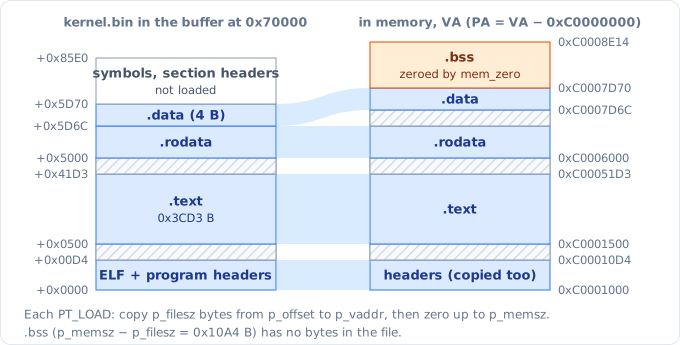
The file layout (offsets from 0x70000) and the memory layout it turns into. The bands are the four mem_cpy calls.
The p_vaddr addresses are above 0xC0000000. That works because paging is on and PDE 768 maps VA 0xC0000000–0xC00FFFFF to the first MiB. As my commit note says, this loader pays for an extra copy: disk → buffer → final place. A smarter loader would read the headers first and then read each segment straight from the disk to its address.
The .bss zeroing was not there at first. It came with printk (c91a8c0), whose cursor_x and cursor_y were the first C globals that had to start at 0.
Then the jump:
    call kernel_init

    mov esp, KERNEL_STACK_TOP       ; 0xC009F000
    ; e_entry
    jmp [KERNEL_BIN_BASE_ADDR + 24]
The kernel stack is the loader’s stack, reset to its top: the loader’s frames are simply forgotten. At the first instruction of main:
(0) Breakpoint 7, 0x00000000c00017b4 in ?? ()
(0) [0x0000000017b4] 0008:00000000c00017b4 (unk. ctxt): lea ecx, ss:[esp+4]       ; 8d4c2404
rsp: 00000000_c009f000
rip: 00000000_c00017b4
Physical memory when main() starts
This is the whole first MiB, plus what lies above it, at the first instruction of main:
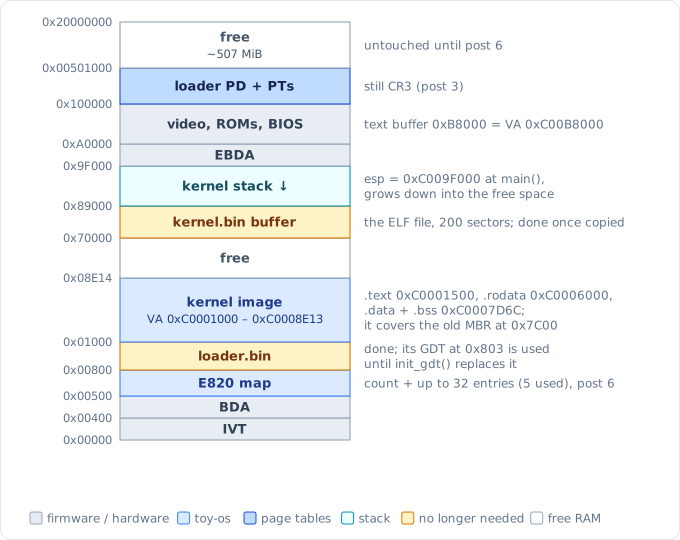
Physical memory at main(). Amber regions are done and could be reused. The whole first MiB is also visible at VA 0xC0000000 + PA.
| Physical | Virtual | What |
|---|---|---|
0x00500–0x00567 |
0xC0000500 |
E820 map: count + 5 entries (room for 32, up to 0x784) |
0x00800–0x00B70 |
loader.bin; its GDT at 0x803 is in use until init_gdt() (post 2) |
|
0x01000–0x010D3 |
0xC0001000 |
ELF + program headers |
0x01500–0x051D2 |
0xC0001500 |
.text |
0x06000–0x06D6B |
0xC0006000 |
.rodata |
0x07D6C–0x08E13 |
0xC0007D6C |
.data (4 bytes) + .bss (GDT, IDT, allocator state, …) |
0x70000–0x88FFF |
kernel.bin as read from the disk |
|
↓ 0x9F000 |
0xC009F000 |
kernel stack, growing down |
0xB8000–0xBFFFF |
0xC00B8000 |
text buffer |
0x100000–0x500FFF |
(recursive window, post 3) | loader page directory and page tables |
A few things follow from this layout:
- The kernel image overwrites the MBR (
0x7C00–0x7DFF), which is fine, since the MBR is long dead. The kernel’s GDT (post 2) ends up exactly in the MBR’s last 128 bytes. - In memory, the kernel can grow up to the buffer at
0x70000, about 444 KiB. The file is the tighter limit: 100 KiB. - Nothing here is reclaimed yet. Post 6 simply reserves the whole first MiB. With a kernel of about 32 KiB, that is simpler than tracking every gap.
kernel.hturns the higher-half rule into two macros, valid for anything in the kernel half:
/* the kernel half starts here, physical address p is at KERNEL_OFFSET + p */
#define KERNEL_OFFSET 0xC0000000
#define phys_to_virt(x) ((void *)((uintptr_t)(x) + KERNEL_OFFSET))
#define virt_to_phys(x) ((uintptr_t)(x) - KERNEL_OFFSET)
First words from C: VGA and printk
The first main (bf3a03a) was just while(1);. Once that ran without faulting, the next commit (c91a8c0) gave the kernel a voice.
The text buffer
In 80 × 25 color text mode, each screen cell is two bytes in the buffer: the character, then an attribute.
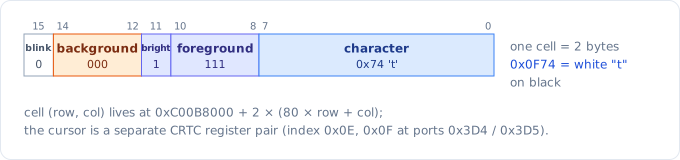
One cell. The kernel prints white on black, attribute 0x0F.
src/vga.c writes cells at 0xC00B8000, keeps its own cursor, scrolls by copying rows 1–24 up one row, and moves the hardware cursor through the CRTC registers:
/* 0xB8000 seen through the kernel alias the loader maps at 0xC0000000 */
#define VIDEO_SEG_BASE 0xc00b8000

void put_char(char c, uint8_t color) {
    uint16_t *video_memory = (uint16_t *)VIDEO_SEG_BASE;

    if (c == '\n') {
        cursor_x = 0;
        cursor_y++;
    } else if (c == '\r') {
        cursor_x = 0;
    } else {
        // char is signed, without the cast bytes >= 0x80 sign-extend over the color
        video_memory[cursor_y * VGA_WIDTH + cursor_x] = (color << 8) | (uint8_t)c;
        cursor_x++;
    }
    ...
}
The comment marks a real trap. char is signed on x86, so a byte like 0xB0 becomes 0xFFB0 when promoted to int. OR’ed with color << 8, that wipes out the attribute byte.
printk and varargs
printk is a thin wrapper: vformat() in lib/stdio.c parses the format and calls a putc callback for each character. It supports %d %i %u %o %x %X %c %s %p %%, the flags - + space # 0, width and precision (* too), and the length modifiers hh h l z.
static void vga_putc(char c, void *arg) {
    (void)arg;
    put_char(c, VGA_COLOR_DEFAULT);
}

/* Characters go straight to the screen, so no buffer limits the length */
int printk(const char *format, ...) {
    va_list ap;
    int len;

    va_start(ap, format);
    len = vformat(vga_putc, NULL, format, ap);
    va_end(ap);
    return len;
}
With -nostdinc there is no <stdarg.h>, but varargs are a compiler feature anyway. include/stdarg.h just names the builtins:
typedef __builtin_va_list va_list;
#define va_start(ap, last) __builtin_va_start(ap, last)
#define va_arg(ap, type) __builtin_va_arg(ap, type)
#define va_end(ap) __builtin_va_end(ap)
On i386, __builtin_va_list is just a char * into the caller’s stack frame. The cdecl caller pushes the arguments right to left, so in memory they sit left to right above the return address:
c00017d2:	push   $0xc00017b4      ; 2nd argument: main
c00017d7:	push   $0xc0006241      ; 1st argument: the format string
c00017dc:	call   c0001adf <printk>
va_start(ap, format) points ap just past format. Each va_arg(ap, int) reads 4 bytes and moves on. Arguments narrower than int (char, short) are promoted to int when passed, which is why vformat reads %hhd as (signed char)va_arg(ap, int).
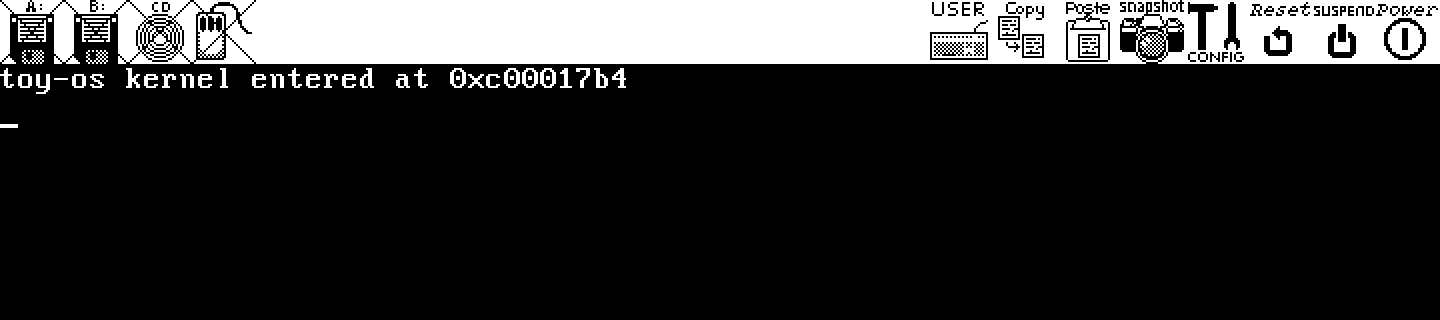
main clears the screen and prints its own address: %p of main = e_entry.
The kernel can talk now, but it cannot listen: any exception would still take the machine down. Post 5 adds an IDT, the 8259A PIC and a timer.
References
- 郑钢, 《操作系统真相还原》, ch. 5 (加载内核: ELF, the kernel at
0xc0001500, the0x70000buffer) and ch. 6 (完善内核: printing to the screen). - navi, 从零开始写 OS 内核 - 加载并进入 kernel and 显示与打印, segmentfault.
man 5 elf:Elf32_EhdrandElf32_Phdr.- System V Application Binary Interface, Intel386 Architecture Processor Supplement: the cdecl calling convention and variable argument lists.
- OSDev Wiki, Text UI and Text Mode Cursor.