SGEMM CUDA kernel (Second Half)
Following the previous blog, this is somewhat of a separate thread, which records my attempt to optimize the SGEMM kernel to the extreme.
I know there are many excellent engineers who have already achieved this, but to be honest, their code is often very hard to understand.
I will update this blog occasionally, as GPU is really not the focus of my work, but it still fascinates me a lot.
Again, source code can be found here.
Table of Contents
Test Environment Setup
After finishing grad school, I have to switch my test platform from the high end AD102GL [RTX 6000 Ada Generation] workstation to the cheapest Google VM I can get with Nvidia L4 GPU
Google has a really nice script that automates the installation of GPU drivers and CUDA tools.
curl -L https://storage.googleapis.com/compute-gpu-installation-us/installer/latest/cuda_installer.pyz --output cuda_installer.pyz
sudo python3 cuda_installer.pyz install_driver
reboot
sudo python3 cuda_installer.pyz install_cuda
reboot
Part 8: Warp Tile (v5)
Nsight Analysis of the previous kernel sgemm_v4
Using Nsight Compute, we can profile and analyze memory behavior.
sudo $(which ncu) --set full -o profile_output -f ./sgemm_v4 4096 4096 4096
ncu -i profile_output.ncu-rep > sgemm_v4.txt
Below is part of the profile result of sgemm_v4.
    Section: Memory Workload Analysis Tables
    OPT   Est. Speedup: 58.32%
          The memory access pattern for global stores to L1TEX might not be optimal. On average, only 4.0 of the 32
          bytes transmitted per sector are utilized by each thread. This could possibly be caused by a stride between
          threads. Check the Source Counters section for uncoalesced global stores.
    ----- --------------------------------------------------------------------------------------------------------------
    OPT   Est. Speedup: 27.27%
          The memory access pattern for shared loads might not be optimal and causes on average a 5.0 - way bank
          conflict across all 134217728 shared load requests.This results in 268435456 bank conflicts,  which
          represent 40.00% of the overall 671091703 wavefronts for shared loads. Check the Source Counters section for
          uncoalesced shared loads.
    ----- --------------------------------------------------------------------------------------------------------------
    OPT   Est. Speedup: 22.72%
          The memory access pattern for shared stores might not be optimal and causes on average a 2.4 - way bank
          conflict across all 20971520 shared store requests.This results in 16777216 bank conflicts,  which represent
          33.33% of the overall 50331648 wavefronts for shared stores. Check the Source Counters section for
          uncoalesced shared stores.
There are two major problems:
- Memory access to global memory is not coalesced, wasting bandwidth. Therefore, threads within a warp should write to contiguous global memory addresses.
- Shared memory load/store conflicts => mostly when loading and storing back to global memory
Better memory access management with warp tile
Credit: The following illustrations comes mostly from Advanced Matrix Multiplication Optimization on NVIDIA GPUs, the same hierarchy was mentioned in this paper Strassen’s Algorithm Reloaded on GPUs.
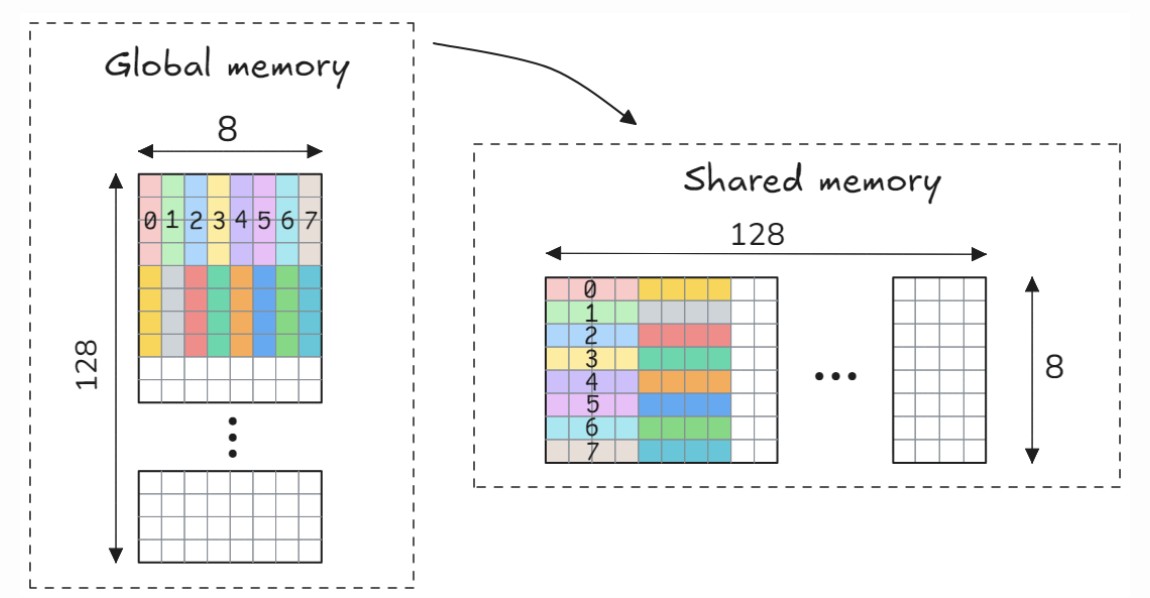
In sgemm_v4, each thread reads off a $1 \times 4$ floats (float4) from global memory and then stores a $4 \times 1$ to AsT shared memory:
float4 a4 = FLOAT4(A[OFFSET(a_row, a_col, M, K)]);
AsT[shmem_col][shmem_row] = a4.x;
AsT[shmem_col + 1][shmem_row] = a4.y;
AsT[shmem_col + 2][shmem_row] = a4.z;
AsT[shmem_col + 3][shmem_row] = a4.w;
However in sgemm_v5, each thread reads off a $4 \times 1$ but stores $1 \times 4$ floats (float4) to shared memory:
auto ld_g2r_a = [&] (int ph) {
      int col = ph * 8 + A_thread_col;
      A_ldg_reg.x = (A_row < M && col < K) ? A[OFFSET(A_row, col, K)] : 0.0f;
      A_ldg_reg.y = (A_row + 1 < M && col < K) ? A[OFFSET(A_row + 1, col, K)] : 0.0f;
      A_ldg_reg.z = (A_row + 2 < M && col < K) ? A[OFFSET(A_row + 2, col, K)] : 0.0f;
      A_ldg_reg.w = (A_row + 3 < M && col < K) ? A[OFFSET(A_row + 3, col, K)] : 0.0f;
};

auto st_r2s_a = [&] () {
      FLOAT4(AsT[A_thread_col][A_thread_row]) = A_ldg_reg;
};
I think both approaches need 128 memory transactions (32-byte sectors) to load $128 \times 8$ floats from the global memory, because each row of the tile is only 8 floats (32 bytes) wide, a quarter of a 128-byte cache line.
However, when it comes to storing into the shared memory, sgemm_v5 uses vectorized store to better utilize the shared memory bandwidth, while sgemm_v4 does not.
Bank conflict-wise (at this stage, before computation), both schemes are clean. Specifically, sgemm_v5 intentionally inserts 4 columns to “shift” away the conflicts.
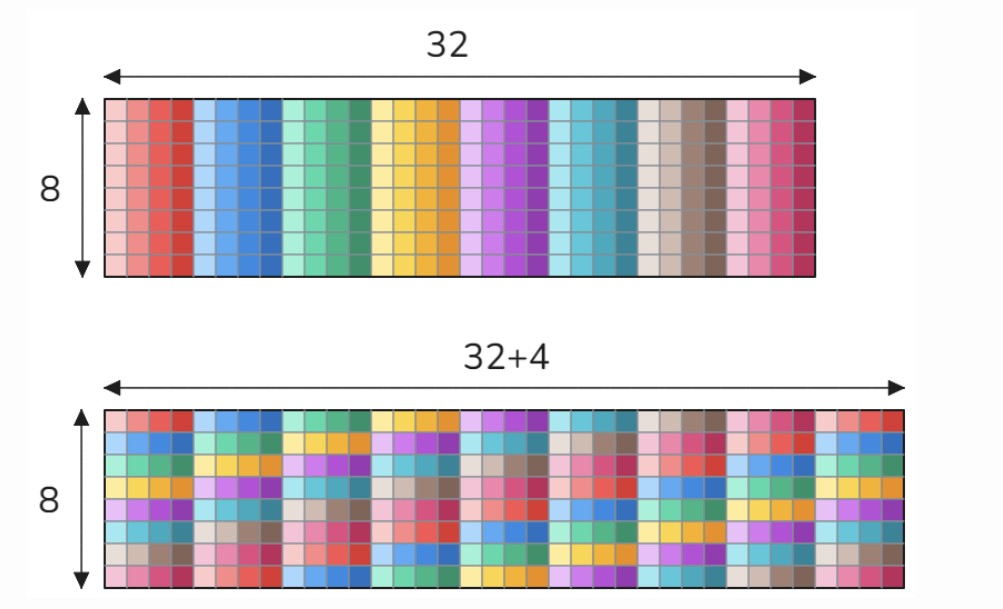
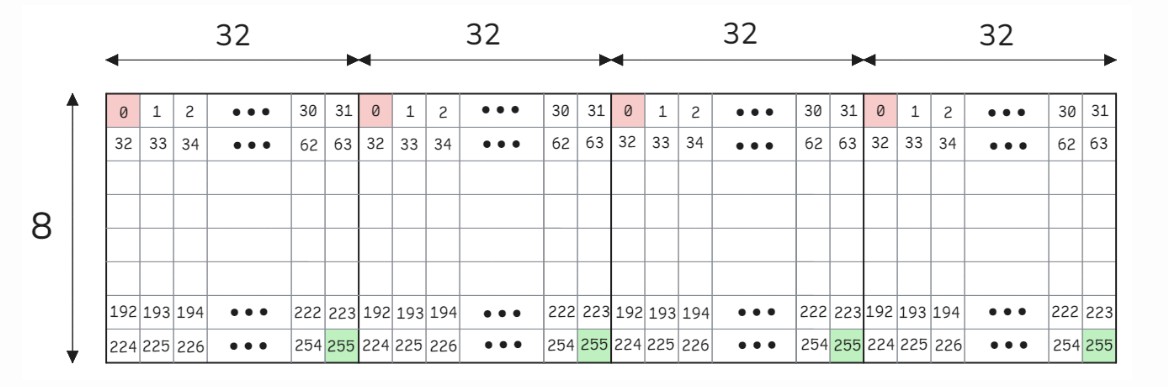
sgemm_v5 also has a very clever memory access arrangement for B. For the most part, all memory load from global memory are obviously coalesced. When storing to shared memory, there are also no bank conflicts.
LDS.128 Shared Memory Transactions
Credit: The following section relies heavily on this Zhihu Blog 搞懂 CUDA Shared Memory 上的 bank conflicts 和向量化指令(LDS.128 / float4)的访存特点 and YHs_Sample sgemm.
The big picture of warp tile looks like this:
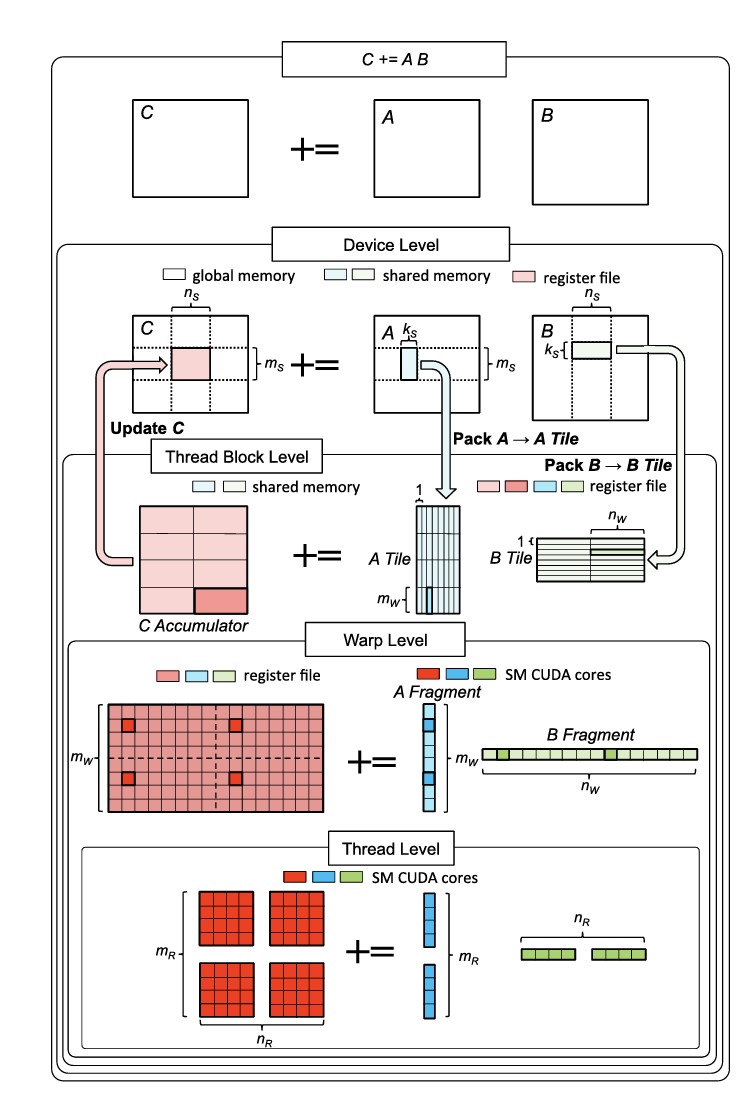
But unlike what one would expect, how threads within a warp are mapped to shared memory is not simple and trivial. sgemm_v5 uses the following mapping.
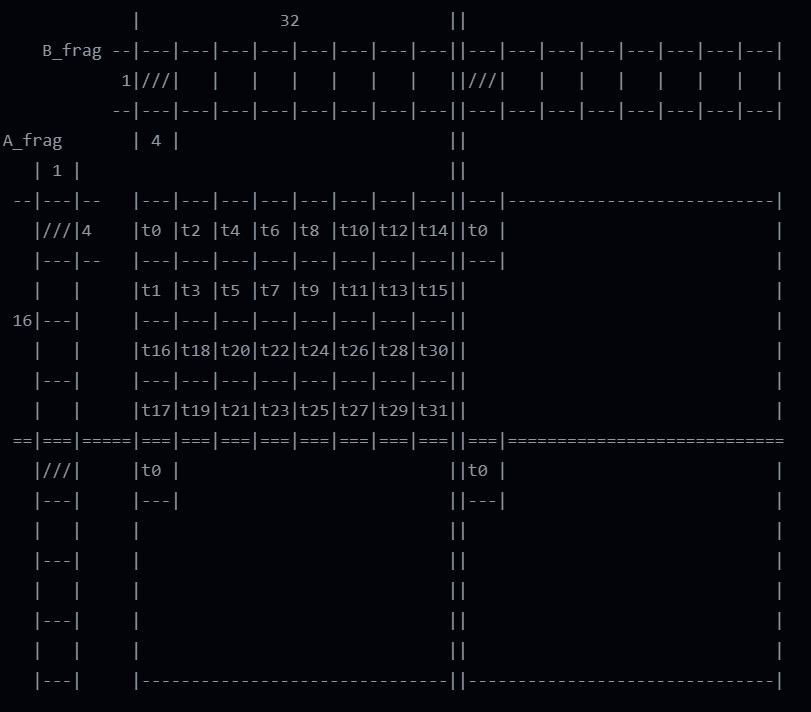
This is because of the presence of a broadcast limitation if we simply put neighboring threads next to each other.
LDS.32, LDS.64 and LDS.128 are the SASS (machine code) instructions used when threads load 32 bits (one float), 64 bits and 128 bits (four floats or float4) from shared memory. Their PTX counterparts are ld.shared.f32, ld.shared.v2.f32 and ld.shared.v4.f32.
LDS.32
- When multiple threads access the same word (32-bit) (thus of course within the same bank), the broadcast mechanism is triggered. That word is simultaneously sent to the corresponding threads.
If all threads within a warp reads the same word, only 1 memory transaction
- When multiple threads access different words within the same bank, a bank conflict occurs. The request is then split into multiple memory transactions, which are issued serially for execution.
If all threads within a warp reads totally different words in the same bank, 32 memory transactions needed.
LDS.64
Each thread requesting 2 words, thus 16 threads together saturate the 128-byte transaction size. The hardware then splits one warp (32 threads) into 2 half-warps (16 threads), leading to two memory transactions.
Only under certain scenarios will these two memory transactions be merged into one. For all active threads in a warp (where active means the thread has a memory access request):
- For thread i, thread i xor 1 is either inactive or accesses the same memory address.
(i.e., T0 == T1, T2 == T3, T4 == T5, T6 == T7, etc.)
- For thread i, thread i xor 2 is either inactive or accesses the same memory address.
(i.e., T0 == T2, T1 == T3, T4 == T6, T5 == T7, etc.)
Example 1: 32 threads accessing 32 consecutive uint2
- Does not meet the above requirements
- First half-warp will access the first 128 bytes, causing one memory transaction
- Second half-warp will trigger another
Example 2:
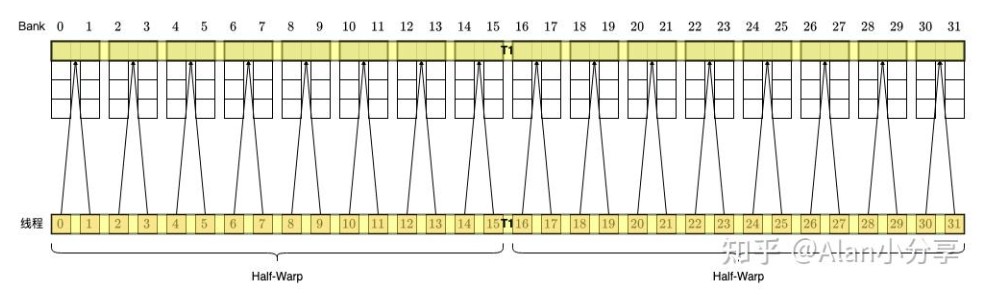
- T0 == T1, T2 == T3, …
- One merged memory transaction
LDS.128
Each thread requesting 4 words, thus 8 threads alone will saturate the 128 bytes of data. The hardware then splits one warp (32 threads) into 2 half-warps (16 threads), and each half-warp into 2 quarter-warps (8 threads), leading to up to 4 memory transactions.
Only when the same rule applies (as the above mentioned LDS.64) will the group of quarter-warp memory transactions be merged into one “half-warp” memory transactions, however these “half-warp” memory transactions will not further be merged into 1, meaning there will at least be 2 memory transactions.
Example 1: 32 threads accessing 32 consecutive uint4
- Does not meet the requirements
- Total of 4 quarter-warp memory transactions
Example 2: Thread 15 and Thread 16 access the same uint4
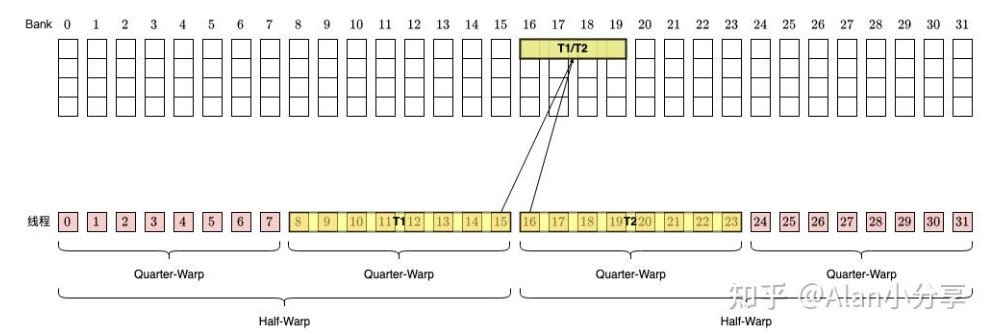
- Does not meet either requirement
- 2 quarter-warp memory transactions
Example 3: Thread 0 and Thread 15 access the same uint4
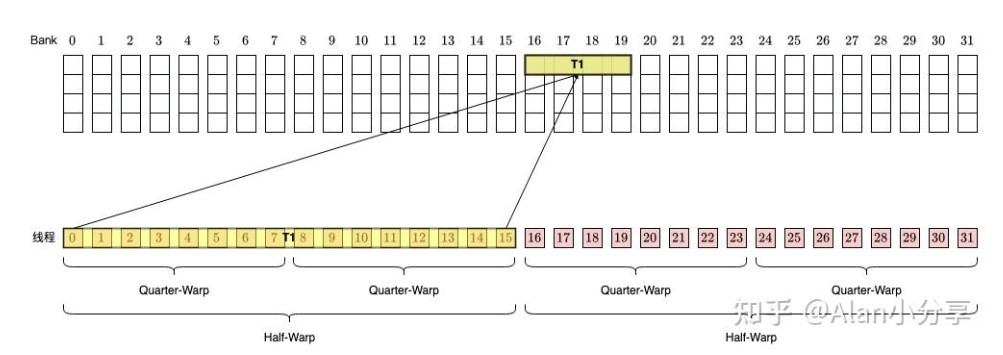
- Meet both requirements
- 1 merged half-warp memory transaction
Example 4: Irregular scenario
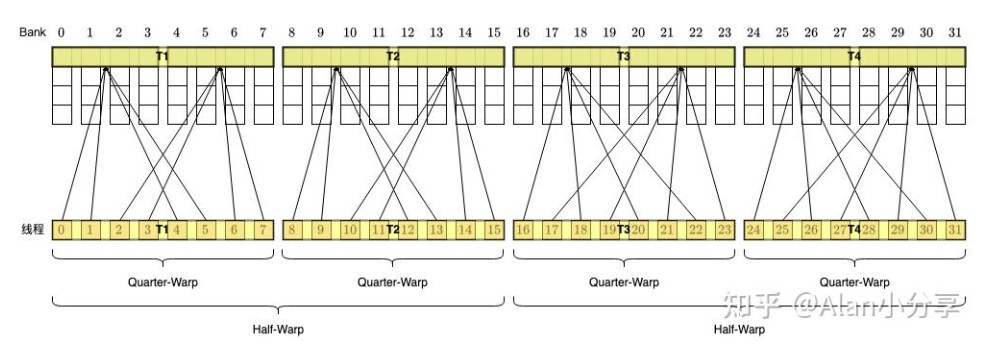
- First half-warp meets the first requirement; Second meets the second
- The requirement needs to be coherent across the entire warp, therefore the warp meets neither the first requirement nor the second
- 4 memory quarter-warp transactions
How it associates with SGEMM kernel here
When threads are reading segments from shared memory, they are progressively reading float4s, and that is the “32 threads accessing 32 consecutive uint4” mentioned in the above section
From the previous sections, we get to see that we should either put
- (t0, t1), (t2, t3), … reading the same word
- (t0, t2), (t1, t3), … reading the same word
And that is exactly what we observed from sgemm_v5:
- When reading col frag from As (row frag from AsT), T0 = T2, T1 = T3, …
- When reading row frag from Bs, T0 = T1, T2 = T3, …
This Z shaped mapping will make quarter-warp memory transactions merged into half-warp transactions
Part 9: Coalesced Writeback using Cs (v6)
In sgemm_v5, I “shuffled” threads within the warp in a zig-zag fashion, as mentioned above, to reduce the LDS.128 memory transactions.
sgemm_v5 directly stores those results from per-thread registers to global memory, and since we adopt the zig-zag layout, they are no longer coalesced. Optionally, we can use shared memory as an intermediate buffer to rectify global memory access pattern.
__shared__ __align__(16) float Cs[8][16][36];
auto st_r2g_c = [&] () {
      #pragma unroll
      for (int i = 0; i < 2; i++) {
            #pragma unroll
            for (int j = 0; j < 2; j++) {
                  #pragma unroll
                  for (int row = 0; row < 4; row++) {
                        FLOAT4(Cs[warpId][frag_row * 4 + row][frag_col * 4]) = FLOAT4(acc[4 * i + row][4 * j]);
                  }
                  __syncwarp();

                  const int c_col = block_col + warp_col + j * 32 + laneId;

                  #pragma unroll
                  for (int p = 0; p < 16; p++) {
                        const int c_row = block_row + warp_row + i * 16 + p;
                        if (c_row < M && c_col < N) {
                              C[OFFSET(c_row, c_col, N)] = Cs[warpId][p][laneId];
                        }
                  }

                  __syncwarp();
            }
      }
};
Each warp writes into its [16][36] intermediate buffer, and then we flush the 16 rows one by one. Note that __syncwarp() instead of __syncthreads() is used, because each warp independently works on its own Cs[warpId] array, we only need threads within a warp to synchronize.
There is an obvious tradeoff to make here, as in sgemm_v6 we have more synchronizations but our store to the global memory is coalesced.
On the Nvidia L4 GPU I am using, this actually hurts the performance a little bit.
Future Works
- Have more illustrations
- Consider bank conflict of registers
- Double buffering
- PTX analysis and so on